

guide to journaling
advice from 10 years of journaling: how to start and keep a journal and how it has helped me grow

For context, I’ve been journaling for ten years. The practice has become one of the most reliable ways for me to untangle my thoughts, face feelings I would otherwise suppress, and develop a clear (albeit evolving) self-concept. So, when a family member reached out to me for advice on how to start but, more importantly, keep up the journaling practice some time ago, I felt I had substantial experience to draw on. She shared frustrations I was familiar with, having heard them from many friends throughout the years: Where do I start? What do I even write about? Why can’t I seem to keep this up?
This letter is written to answer these questions and offer advice for anyone looking to embark on a journaling journey. It brings me such joy to share a practice that has brought me undeniable inspiration, solace and growth with the hope that these tips will help you get started.

my experience —
Journaling has been an almost daily practice for me since I was 13. I had a little notebook called my Book of Everything. Whatever I thought of, I scribbled down in that little book- from school notes to (bizarrely vivid) dreams for my life. At the time, I didn’t quite realise that I was journaling since there was little order or structure in the way I used my notebook, but it was the perfect system for me. I’ve since learned that this practice could more accurately be described as keeping a commonplace book, but I’ll just call it journaling for this letter.
Initially, a huge part of journaling was just about coping for me- having an outlet that allowed me to unravel and process the jumbles of thoughts, fears and ideas that existed in my head. Looking back on my teenage years, I realise that was one of the greatest signs of kindness I showed myself. It was a way of showing love to myself even when I didn’t feel it. Through journaling, I gave myself and all my perplexing emotions and internal conflicts somewhere to release. And as I did, I learned what my voice sounded like even when no one else was listening; I discovered my dreams and watched them evolve.
Since then, I’ve continued to use journaling to inspire and document personal growth and my spiritual journey (so many of my entries are prayers), get in tune with my intuition, deal with pain, and improve my well-being. My journaling practice serves as an ever-growing archive of my history of healing, learning, unlearning, and growth. This is the side of journaling that I’ll share today. There isn’t a cookie-cutter “right” way of doing it, but these suggestions will start you off on a practice you can make your own.

essential tips —
make it a habit
Like with anything else, you will only really experience the results of journaling if you make it a habit. But don’t let the thought of that overwhelm you. Think of it as a gift to yourself, a loving activity to punctuate your mornings or nights (or both). This way, you’ll come to feel that journaling has an actual place in your daily routine instead of it being something that you just do sporadically that is easily forgotten. Having a reminder might help you settle into the habit when getting started.
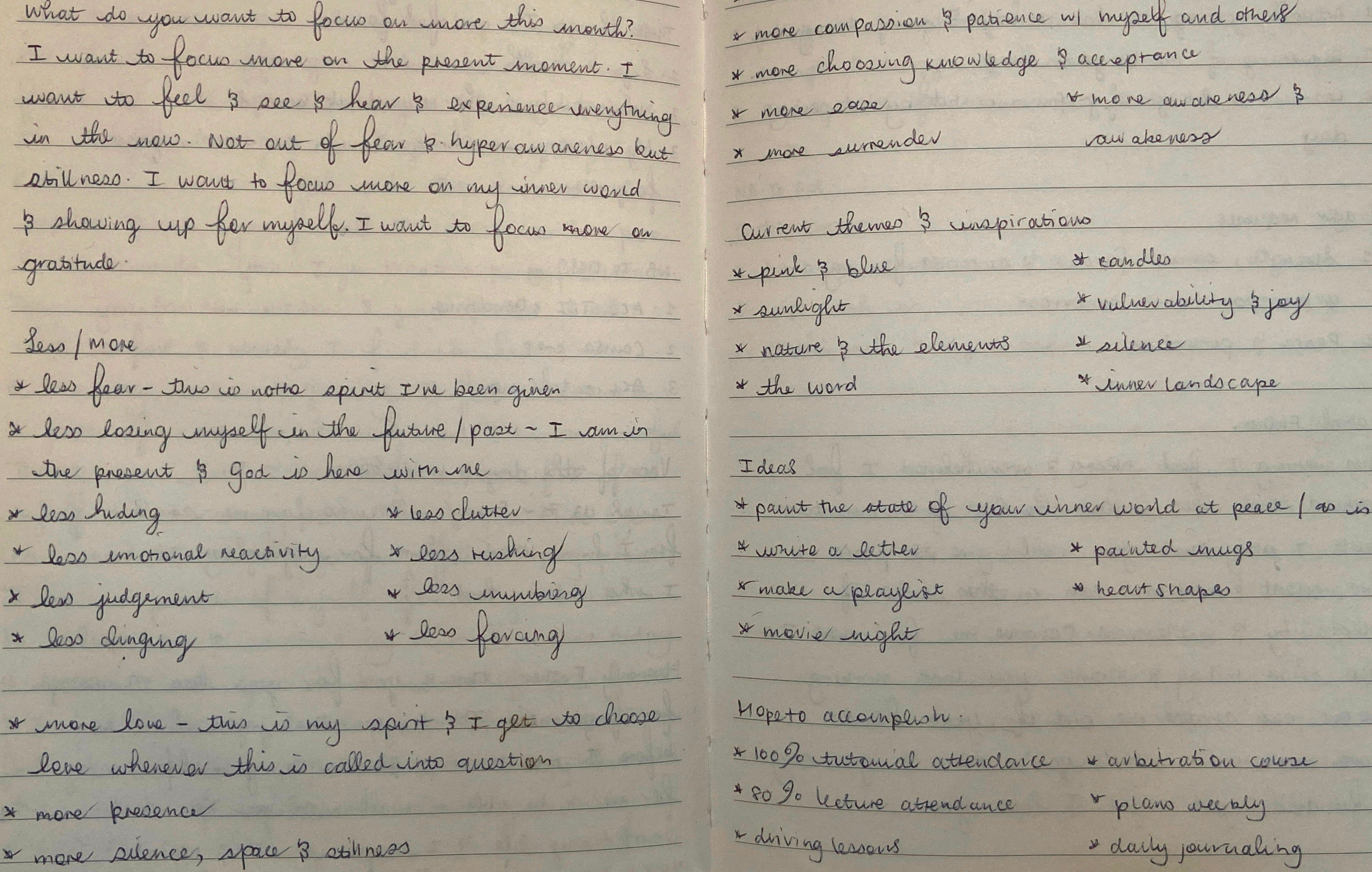
My evening journaling sessions are usually lengthier and include ‘stream of consciousness’ or brain splurge entries, describing highlights or lowlights of my day, planning my goals for the next day and prayers. My morning journaling sessions are typically quicker with a purpose: practising gratitude, writing morning pages and setting my priorities for my day.
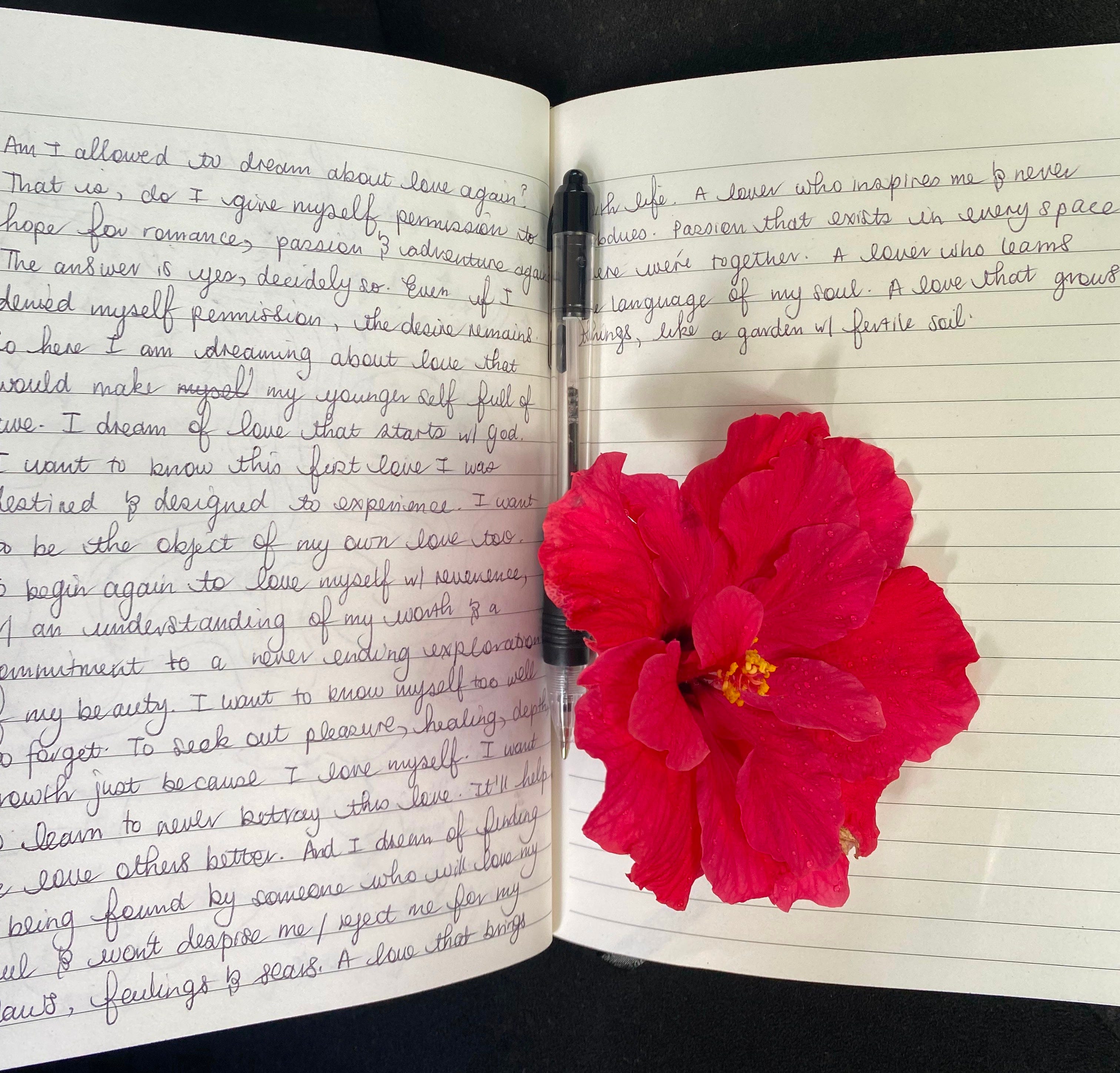
The real fun comes with the free-flowing entries, whether that is writing lists of things I love at the moment, writing out my mission statement for life and revising it as I grow or exploring any themes that feel current in my life.
practice non-judgement
Part of what deters some people from experiencing the cathartic benefits of journaling is that they try to write the ‘right’ thing. It’s easy to think journaling is only valid if you write a ‘dear diary’ entry recounting your day’s adventures or that only passionate and profound thought pieces make a ‘real’ journal. At some point in my history, I began to try and copy how other people were journaling because it seemed more correct. This made me lose my spark for a while, but it also helped me realize how important it was for me to stay true to myself in all things- including journaling.
I invite you to set aside whatever preconceived notions you have of journaling as you embark on your journey. Your journal is for you and you only. There is no need to hold back or restrict what you write. Directing your entries is also unnecessary, even if you use prompts. Let your mind (and pen) lead you naturally. This is a key aspect of tuning into your inner self and intuition.
start with where you are
Where you are in life now is the most relevant place to start with your practice. Don’t worry yourself by trying to rush and document past moments. If there is a need for that, it will happen organically. A good rule of thumb for journaling beginners is to focus on your current reality: What are your thoughts, dreams, fears, and experiences now? What is happening in your daily life? What is changing? What do you want to change?
know your limits
I’m all too familiar with thoughts that run amuck. Thoughts that are frightening and overwhelming, threatening to drag you down into a spiral if you linger on them. I’m also aware that sometimes when I turn my focus to darker thoughts, I am in danger of over-identifying with them and elevating them to the position of truth. For this reason, I recommend you keep your journaling varied. It’s not every day that you need to delve into the depths of your mind. Sometimes, staying in the safer zones of your mind is just wiser and more productive. When I find myself in these mental states, I look to journaling for comfort- sticking to gratitude lists and exploring my favourite things on paper- or I let my journal rest until I’m ready again.
general tips —
tips that are not strictly necessary for your practice, but I’ve found they help me keep my practice regular and impaired
keep your journal with you
Always having my journal near me has been the key to using it regularly. No matter where I find myself in a day, I can pull my journal out and write. By doing this, you’ll find that in the lulls of the day- when you might usually turn to your phone for distraction- you can instead turn to your journal. This will also make it easier to stay on track with your practice when you’re starting off. It’s for this reason that I recommend a small A5 journal- it’s easy to bring along with you wherever you go.
make it beautiful
I try to surround myself with beauty as much as possible, and this has translated into my journaling practice. I fill some pages with pressed flowers and leaves, others with drawings and magazine clippings. When I’m not in a hurry, I use colour in my entries and different mediums to make the pages look more interesting. I’ve found that this makes me enjoy journaling that much more.


This tip won’t apply to everyone, but I thought I’d share it, nonetheless. You’re more likely to continually engage with things you enjoy and adding beauty to your practice will likely keep you coming back for more. For beginners, a good starting point is having a book that you enjoy looking at. Find something that suits your style, whether that is colourful, plain or textured.
We write to heighten our own awareness of life…
We write to taste life twice, in the moment and in retrospection…
We write to transcend our life, to reach beyond it…
It should be a necessity, as the sea needs to heave, and I call it breathing.
―Anaïs Nin
journaling prompts to get started —
Journaling prompts help you gain direction when writing journal entries. Here are some beginner-friendly prompts, many of which I still use in my practice.
Check-Ins: How are you feeling today? What is the state of your mind and body? Is there anything you can do right now to feel more at ease?
Daily and Weekly Reflections: What have the highlights and lowlights of your day/week been? What adjustments can you make for the new week to stay on purpose and aligned. What made your heart feel full of joy? How can you incorporate more of that into your life?
Practicing Presence: Name one beautiful thing you experienced; the changing colours of the sky, a heart-shaped leaf, a dream come true, an afternoon with people you love etc.
Facing Fears: Is there a fear that is controlling the way you behave? Name it and acknowledge it. Is it a product of your true reality, a figment of your imagination, or a thought planted by an external source? How can you deal with it?
Practising Gratitude: Write a list of things that you are thankful for and meditate on them. Try to make them specific so that you’re not just spouting off a list.
Prayers or Streams of Consciousness: Write a prayer or stream of consciousness that is honest, raw and unrestricted. Write about whatever’s in your heart with absolute authenticity, resist the urge to hide the parts that you may feel are wrong or make you feel vulnerable. Write continually for 5-10 minutes or as long as you need.
Self-Love: Write a letter to your younger self. If you loved yourself, how would you live this day? Write down self-love affirmations. What’s a loving commitment you can make to yourself today? Who inspires you? What boundaries do you need to set for yourself? What does your perfect day look like?
Write Your Mission Statement: One way I have come to explore purpose actively is through writing and revising my personal mission statement. It’s a practice that keeps me engaged as I navigate my life, and it’s an exercise fitting for any new beginning If this is intriguing to you, read more in the letter I wrote on this here.
Write about who you are now and who you want to be, not some idea of who you think you should be, but grounded in your current understanding of yourself and shaped by your intuitive awareness of your highest self. Deep down, I believe we all know something of why we're on this planet- it may just take some digging to discover all the gems that lie within you, destined to be unearthed.
Again, there’s no one-size-fits-all when it comes to journaling. Over time, you’ll learn what is authentic and serves you versus what feels forced. You can always adapt your practice accordingly along the way. Hopefully, these tips will make the idea of journaling regularly less daunting and will set you off on a journey of self-love, acceptance, gratitude and peace.
truly,
T